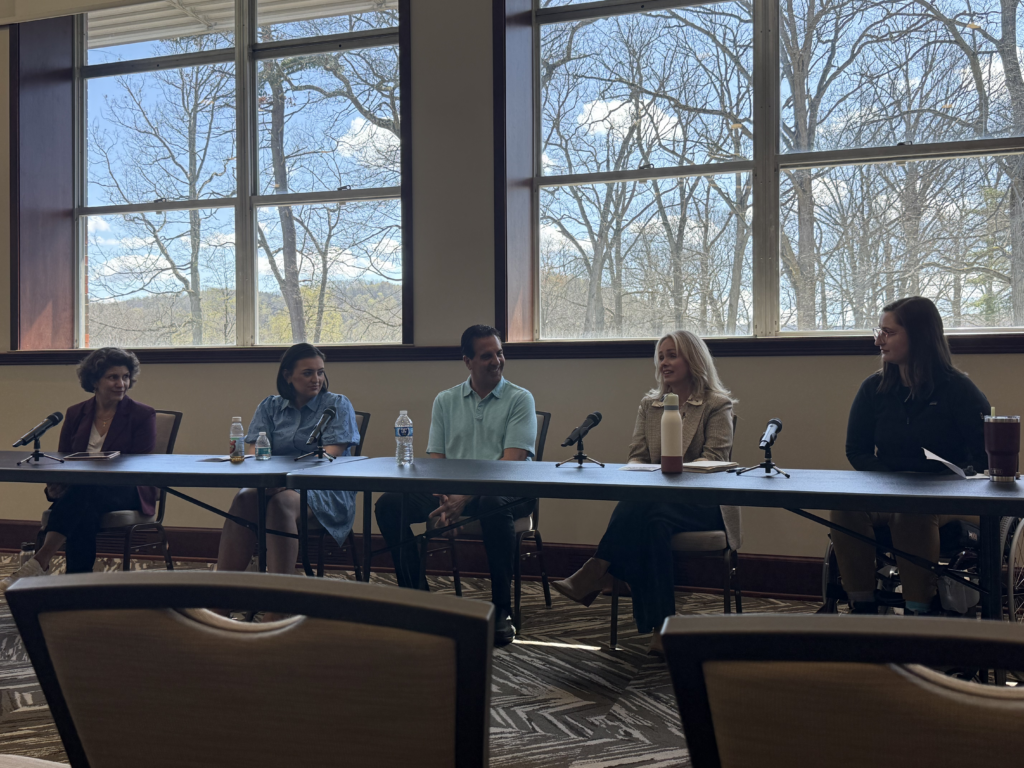
Amy Moritz, Allie Elkins, Mike Corey, Kate Welshofer and Emyle Watkins
Photo courtesy of Chris Doody
BY: CHRIS DOODY, CO-EDITOR-IN-CHIEF AND LILY PETERSON, NEWS EDITOR
The Access and Belonging Advocacy Group (ABAG) hosted Representation Day at St. Bonaventure University, featuring 11 panelists over three panels, on April 17.
Representation Day brought together writers, artists, content creators, filmmakers, academics, broadcasters and journalists to explore how stories are told–and who gets to tell them.
St. Bonaventure students Conor Amendola, a senior media studies major, and marketing communications graduate student and Alexis Serio, a junior faith and social justice/Spanish double major, helped organize this event along with ABAG faculty to increase awareness of the importance of diversity and representation in the workplace, but also in life in general.
“As a Media Studies major, representation in media has always been a topic I’ve thought was interesting and important for both producers and consumers in the industry to talk about,” said Amendola. “It’s also the exact kind of work ABAG does within the [Jandoli] school. We had talked about doing a panel like this last year in the spring and we started planning this last semester. Our first steps were to nail down our topic ideas for the panels and we quickly settled on the three we had at the event: narrative storytelling, communities telling their own stories, and sports reporting and journalism. For this event, we kept our panelists close to Bonaventure, but in the future, we hope to not only do this kind of event again, but start to broaden our reach.”
Serio also commented on the importance of representation and how meaningful it was for the event to happen.
“This event has been in the works for over a year,” said Serio. “I’m so grateful we finally were able to make it happen and this specific group was particularly impactful. Proper representation of groups is key to learning how we relate to one another in impactful ways. The takeaway is truly we are all a part of one human family and it matters how our stories are told!”
The first panel was about telling the story: Voice, perspective and creative expression. It featured Caitlin Smith, Noah Mathew Howard, Janell Clingenpeel and Danny Bush.
The second panel was about communities telling their own stories. It featured Emyle Watkins, Fileve Tlaloc, Scott Sackett and Allison Braun.
The third panel was about telling the full story: How sports media shape what audiences see. It featured Kate Welshofer, Emyle Watkins, Allie Elkins and Mike Corey.
Information can be found about each panelist in greater detail on our website: https://www.thebvnewspaper.com/.
Dr. Tara Walker, associate professor of communication, moderated the second panel and commented on the various ways that the panelists had described diversity in their own communities.
“I think a lot of people have this idea of how we define diversity, but there are so many different communities that we don’t even see,” said Walker. “By looking at diversity a little closer, we can see how many pieces make up a diverse population.”
Allison Braun, local artist and Olean Public Library employee, shared how overcoming her fear of societal judgement helped her embrace her love for art and improve her mental health and lifestyle.
“I got to a point when I kind of shut down for a bit and just let things happen to me,” said Braun. “I had to figure out a way to find my voice and if people didn’t want to listen I needed to find a way to speak louder.”
Braun said that people tend to get frustrated and discredit people that have different life stories than them. Being a member of the queer community and the disabled community, she wants to help others be heard by their own communities, whatever they may be.
“Don’t just doubt everything people say because it’s not your lived experience,” said Braun. “Just listen to people; we all have our lived experiences and they deserve to be heard.”
Similarly, Dr. Fileve Tlaloc, “multigenerational, Creole-South African-American multimedia artist and anthropologist,” according to the Representation Day 2026 program, emphasized how diversity can be a challenging topic for many people of other communities to understand and changing how you describe it may be necessary.
“You need to look at diversity in a different way,” said Tlaloc. “Your story is going to change a little bit depending on your audience.”
Some individuals have become very good at getting stories across a wide audience, which was displayed in the third panel by four different journalists.
Kate Welshofer, lecturer and head of the broadcast journalism program at St. Bonaventure University’s Jandoli School of Communication, spoke on the third panel about her experience as a producer, reporter and anchor covering content for stations all over New York State.
During the panel, Welshofer said she had to find ways to make a difference in storytelling as not everyone tells stories the same way. She found that telling stories in a different way can change the way some viewers think.
“One of the most interesting/funny things I was told when Most Buffalo started to gain some traction was, ‘I didn’t want to like you, but I do,’” said Welshofer. “I heard this more than a few times from different people! I consider it a compliment. Yes, it’s also kind of an insult, but it showed that by continuing to build something we believed in, we were able to build the audience too, even though many of them went into it with preconceived and pretty negative notions of what ‘another newscast’ was going to look like.”
Welshofer said she thought this was because they implemented an element of surprise.
Welshofer said she was glad she took notes during the panels, so she could look back on the conversations discussed.
“A recurring theme that really landed with me and I think is good for all of us to remember is to, as one panelist put it, ‘look at things through a curious lens,’” said Welsofer. “I also appreciated the conversations about not being afraid to ask questions, even if we do so imperfectly, and to also go out of our way to experience new things in an effort to better understand and appreciate the world around us. As I was listening, I was thinking those are all things I can work on and actions I know will make me a better human and a better teacher.
Allie Elkins, weekend anchor and news reporter at NewsChannel 9 WSYRTV in Syracuse, NY and sideline reporter for the Rochester Knighthawks of the National Lacrosse League, according to the Representation Day 2026 program, gave students advice on how to start their careers in the media.
“I hate when people say ‘in the real world,’” said Elkins. “College is the real world. Nothing is stopping you from telling stories now.”
Being a ‘25 Bonaventure alum, Elkins used her recent college experiences to convince students that being a journalist doesn’t have to start after graduation.
“Do it here. Do it now,” said Elkins. “Find something you are passionate about– you don’t need your degree to start being a journalist.”