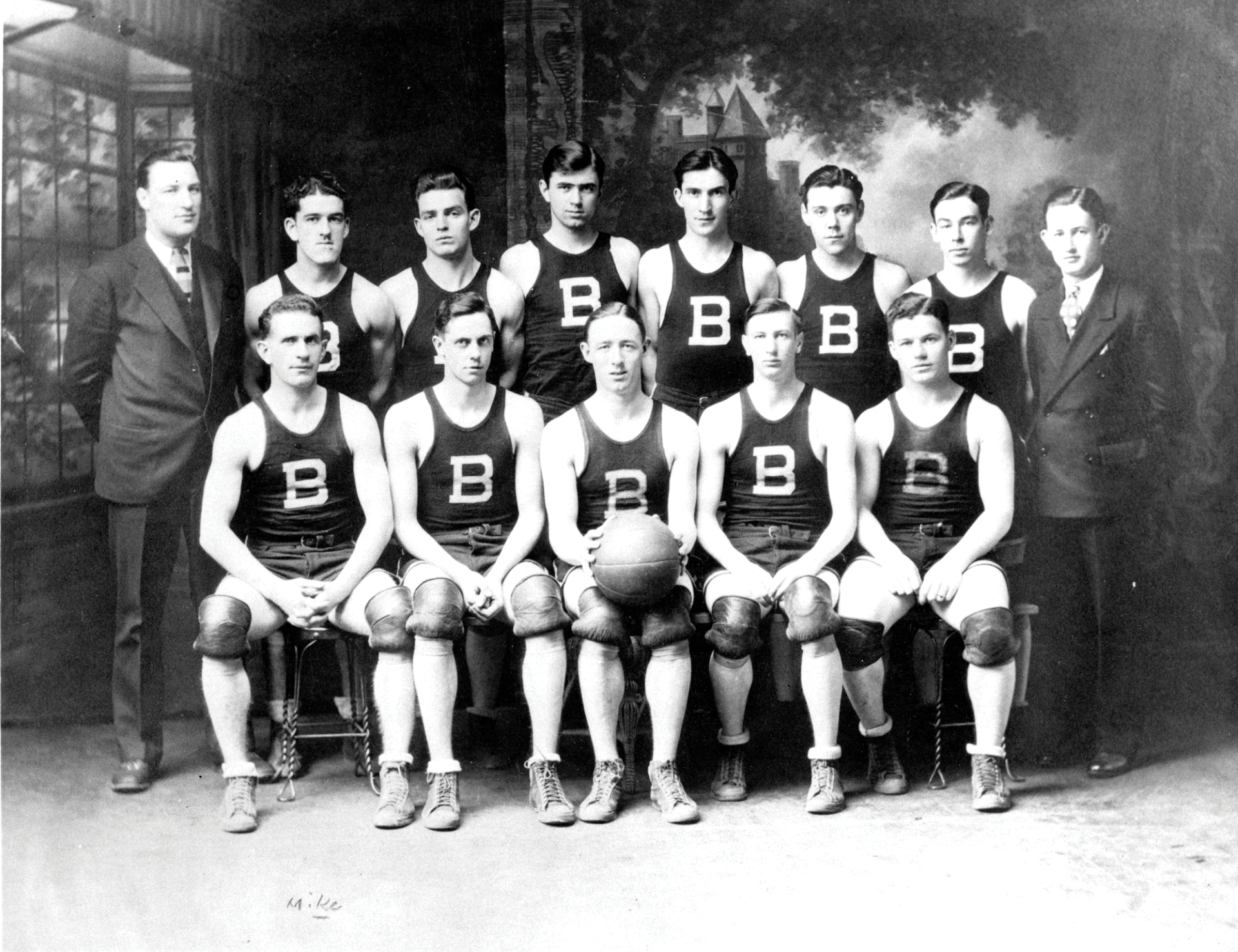
Photo courtesy of St. Bonaventure University Archives
BY: STEVE HAYES, ’88; GUEST CONTRIBUTOR
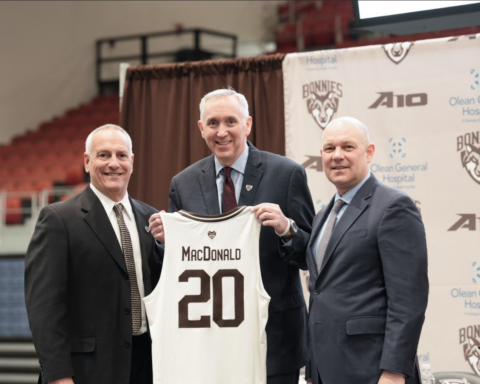
The St. Bonaventure men’s basketball team just hired its 20th head coach. One hundred years ago, the program was still finding its footing — and one season in the Allegany hills provided a preview of what Bonaventure basketball would look like for the next century.
The 1925-26 St. Bonaventure men’s basketball team finished 15-6. They lost once at home all season. They played in a gym that doubled as a dance hall on game nights, with local high school teams opening the card and a swing band closing it. And in February 1926, on a night the Olean Times called the most sensational in Butler Memorial Gymnasium history, they came back from eight points down at the half to beat rival Alfred and send the crowd into a frenzy.
The program’s roots run deeper than most realize. In March 1901, the student newspaper The Laurel noted that “the basket ball craze has struck the college at last.” Intramural competition followed, documented as early as 1905. By 1925, it had grown into something ready to be tested against real competition — and win.
Head Coach Glen “Judge” Carberry was a former Notre Dame football captain, a law graduate, and an early professional football player who ran open tryouts following the close of the Bonaventure football season and handed the ball to whoever could compete. The roster was filled out by multi-sport athletes in the truest sense — football players who became key basketball contributors not despite their other sport, but because of it. A lineman’s physicality, a quarterback’s court vision, a boxer’s willingness to take a hit and keep moving. Paul Ryan of New Haven, NY lettered in football, basketball, baseball, and boxing in the same academic year. It was a different game, played by different kinds of athletes than you’ll find on any roster today.
At the center of it was Charles “Bo” McMillen of Rochester, NY — a player who had suited up for the Bona prep squad before being promoted directly to the college varsity when a teammate left school, eventually logging five years of varsity basketball. Captain William “Billy” McCloud of Ilion, NY ran the team.
After two weeks of practice, the Bonnies opened against their own alumni and won 15–10. “Hard and fast,” the papers said. They were off.
Bonaventure’s first road test came early and wasn’t pretty — Colgate beat them 51–29 in January. But the Bonnies came back the following week to beat Villanova 20–17, becoming the only Little Three team that season to knock off the Wildcats during their western New York swing. Villanova had already beaten Niagara and Canisius. Bonaventure stopped them cold.
February was when the team really caught fire. Four straight road wins, including a sweep in Albany, set up the signature game of the season. February 12, at home against Alfred. Butler Gym was packed. Bona trailed 12-4 at halftime. Then McMillen, McCloud, Cronin, and Gavigan all hit field goals in the third quarter as the crowd roared them back. Final: 22-19. The Olean Times ran out of adjectives trying to describe it.
Two nights later, they edged the Olean Metros — a local professional club team — 15–14 at the Olean Armory. Carberry sent in the rested varsity five late to protect a one-point lead. Another grind. Another win.
The season’s only home loss came against Niagara in mid-February, when McMillen’s last-second shot rimmed out. Thirty seconds from a tie. A detail that feels familiar to anyone who has watched Bonnies basketball across any era.
The finale came on St. Patrick’s Day at the Olean Armory, moved there to hold the crowd expected for the final game of the season. The opponent was St. Francis of Loretto. Decades later that same program would be led to its first NCAA Tournament appearance by Jim Baron — a member of Bonaventure’s 1977 NIT team — who returned to Allegany as Bonnies head coach from 1992 to 2001 and now holds a place in the SBU Athletic Hall of Fame himself. In Bonaventure basketball, the threads never really end.
It was senior night for McMillen. He got a standing ovation when he left the game. McCloud, hurt in practice the day before, suited up anyway. “I wanted to play my last game as captain of St. Bonaventure’s,” he said. He scored six points. Bona won 24–13.
What McMillen did next was its own kind of statement. Already recognized as the first Bonaventure basketball player to earn national honors — honorable mention All-American in his senior year — he was approached after the season by the Olean Metros, the same professional club team the Bonnies had beaten on the floor weeks earlier. He turned them down. McMillen entered the Franciscan order, becoming Rev. Gervase McMillen, OFM. In 1972 he was inducted into the St. Bonaventure Athletic Hall of Fame. The court had given him a platform. He used it for something else entirely.
The team was celebrated at a postseason banquet led by University President Fr. Thomas Plassman O.F.M. Then most of the players put on cleats. These were not specialists — they were athletes, and baseball season was next.
Carberry left after that season for Michigan State, then Fordham, then a long legal career with the Veterans Administration. Coaches move on. The program they build stays.
What the 1925–26 season proved was that the identity was already forming — tough, community-rooted, capable of making up ground when the other team thought the game was settled. The program didn’t need a landmark facility or a deep budget to compete. It needed the right people in the gym with something to prove.
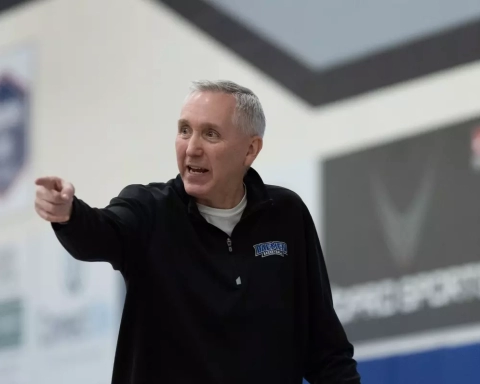
One hundred years later, Mike MacDonald returns to Bonaventure as the program’s 20th head coach — a 1988 graduate and the only coach in college basketball history to reach 100 wins at each of the three NCAA division levels. He has won more than 500 games. He built Daemen into a national power with five scholarships. He is coming home.
What he brings is a career defined by developing players others overlooked, winning against better-resourced programs, and building teams that reflect the community they represent. His teams have always played the way Bonaventure basketball looks when it’s right — hard-nosed, connected, and dangerous when the other team thinks the game is over.
That was true in 1926, when a packed Butler Gym watched a team claw back from eight down on a winter Friday night.