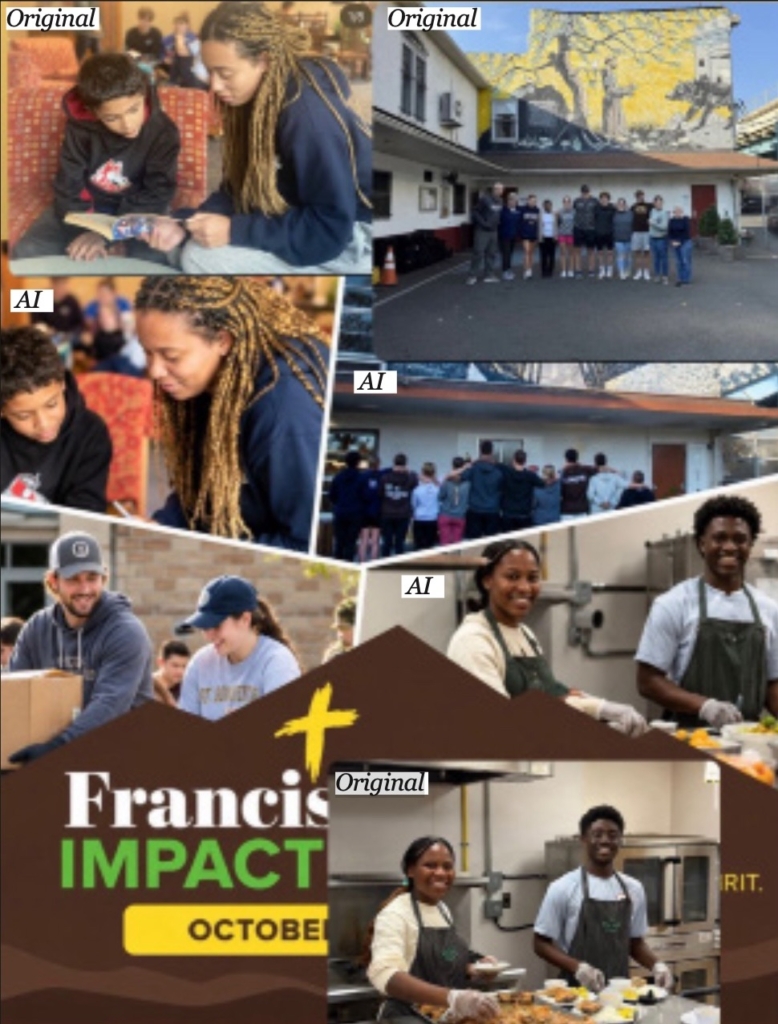
AI graphic used by UMIN compared with the original images.
Photo courtesy of Yik Yak.
BY: KEGAN MCCALLUM, NEWS STAFF
Artificial intelligence, especially large language models, have caused a shift in the way people view reading and writing. People are now having to ask themselves if whatever they are reading was written by a human or generated by an AI. This newfound skepticism has led every piece of writing to be questioned, even pieces written by professionals.
The issue of effort or efficiency goes all the way to the top. In an email from Dr. Jeff Gingerich, president of St. Bonaventure University, Good News for St. Bonaventure in the U.S. News Rankings, sent to students and alumni alike, according to ZeroGPT, contained 85% AI-written text with a high likelihood of the text being AI-generated. Gingerich’s email said, “No ranking can fully capture what makes St. Bonaventure special or the impact of a Bonaventure education.” What once could be interpreted as a thoughtful message announcing the growth of the school is now in question.
St. Bonaventure University using LLMs to write the president’s message to students fits with the university’s method of approach with AI. St. Bonaventure has attempted to integrate the school’s curriculum with AI., spending $50,000 for AI curriculum projects, even to the extent of adding a chatbot to students’ “my.sbu” page.
“Algorithms lack the spark of humanity,” wrote Pope Leo XIV on X. The Vatican has warned the world about AI usage in Magnifica Humanitas: “They may imitate language, behavior and analytical skills, or even simulate empathy and understanding, but they do not understand what they produce, for they lack the affective, relational and spiritual perspective through which human beings grow in wisdom.”
AI has not only taken over written works at St. Bonaventure; AI images and posters have flooded St. Bonaventure. One of those images changed the facial structure and haircuts of two students working at the SBU warming house.
“Yes. AI was used… some of the original photographs provided by University Ministries were unintentionally altered in the process,” said Paul Redfern, chief marketing and communications officer, in an interview about the AI-generated images. “The intent was to incorporate the photographs into a design, not to change their content.”
Redfern continued to claim that although the changes were “unintentional, we are responsible for the materials we publish.”
But this is not the only instance of AI image generation used by the university. For SBU’s Spanish tour information meeting, AI morphed multiple students’ faces to the point of them being unrecognizable. It also included generated pictures of places that do not exist.
The concern is whether or not administrators are choosing efficiency or effort. A poster promoting an informational meeting for a Spanish tour could not take more than 15 minutes or more of work to create. In the same breath, it would take roughly one minute to generate using AI. The same argument is used for students as well. If a student were to generate their writings or images for a class, there would likely be repercussions; but when faculty or administrators do it, they are allowed to hide behind the guise of simply optimizing their workflow.