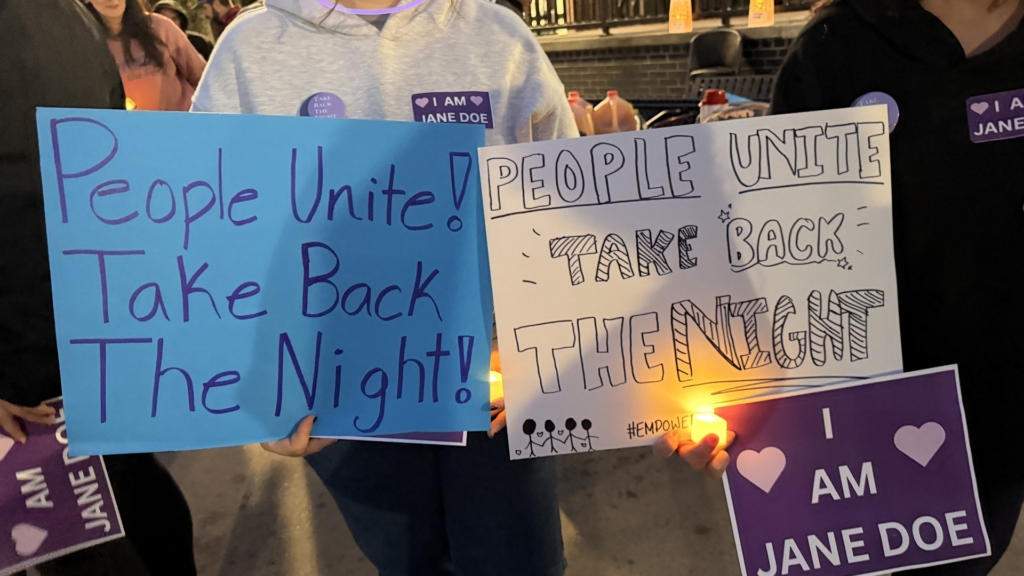
Students holding posters from the Take Back the Night event
Photo courtesy of Julia Beardsley
BY: JULIA BEARDSLEY, STAFF WRITER
On Oct. 6, students, faculty, staff and community members gathered for EMPOWER’s annual Take Back the Night event, joining a movement that has fought sexual and interpersonal violence for nearly 150 years.
Take Back the Night is one of the earliest global efforts to confront violence and fear. The first documented march took place in 1877 in London, where women protested the danger they faced walking alone at night.
By the 1970s, violence against women had become a national conversation in the United States as incidents in major cities including Philadelphia, San Francisco and Los Angeles, gained widespread media attention. In 1972, women at the University of South Florida marched across campus demanding safety and resources. The phrase, “Take Back the Night,” was later used during a 1977 memorial at an anti‑violence rally, becoming a defining call for survivors and advocates.
By the 1990s, hundreds of campuses across the country were hosting their own Take Back the Night events, working with advocates to support survivors and pushing for policy change. Today, the tradition continues: walking, speaking out and standing together remain powerful ways to break the silence surrounding sexual and domestic violence.
The event began outside of Plassmann Hall, where members of EMPOWER handed out stickers, pins, signs and glowsticks for the participants. The steps of Plassmann were decorated with candles and white bags labeled “I am Jane Doe.” The event is designed to represent a vigil, used to gather and honor the importance of the event.
Kirra Bentley, a sophomore psychology major, opened the program by reminding attendees of the goals and significance of the program.
“Tonight is about taking back spaces that have been made to feel unsafe,” said Bentley. “It is about saying that sexual violence is never the survivor’s fault.”
It is about challenging the silence and stigma that can surround these experiences. Most importantly, it’s about supporting survivors and reminding them that they are not alone.
Members of EMPOWER shared poems, speeches and personal reflections throughout the beginning of the event. Noah Trapp, a senior video production major, spoke about the responsibility of positive male bystanders.
“Being a positive male bystander starts with holding yourself and your friends accountable… Instead of staying silent to fit in, challenge your friends and remind them that respect matters,” said Trapp. “Staying silent can allow harmful behavior to continue, but speaking up can make a difference.”
Trapps’s message echoed a theme repeated throughout the night. Now, more than ever, members of EMPOWER ask that students use their voices, challenge harmful behavior and protect one another.
Take Back the Night served as a platform for students who are frustrated by recent events to be able to come forward, express their concern and find unity among their peers in a safe and controlled environment.
On-campus students have had mixed reactions of concern and confusion over the outcome of sexual violence at Cornell University.
“It gives the idea that you can be this person that is not kind, and that you can get away with certain things, and you can still have these positions that you have, and not have consequences,” said Madeline Thornton, a junior psychology major with a business administration minor.
Thorton said she feels that it is important to take advantage of the media focus and speak out about your experiences to maximize the possibility of change, overcoming the societal stigma that surrounds sensitive topics like sexual violence.
“With the influx of media and awareness surrounding certain events, now, more than ever, it is important to take viable action,” said Thornton.
Bently emphasized that, to see change, allyship cannot just be a one-time action; it has to be a long-term commitment.
“I hope tonight reminds us that being an ally and a good bystander is not just about showing up for one night,” said Bently. “It is about listening to survivors, believing people when they come forward, respecting boundaries, practicing affirmative consent, speaking up when we see harmful behaviors, and helping create a culture where everyone feels safe.”
After a speech made by Melissa Parisi, the university director of sexual violence prevention and education, and by Christa Mascho, the on-campus Victim advocate, Amisha Khadka, a senior english major, concluded the student speeches with a poem.
Khadka ended the poem by saying “How unfair is this world when safety comes with rules for the people who are afraid, instead of consequences for the cruel? So tonight, I’m not changing my clothes. I’m not lowering my voice. I’m not apologizing for taking up space. Tonight, I take back the night. I take back my voice. I take back my body. I take back my right to walk without fear.”
After the speeches, attendees walked across campus holding small candle lights and signs displaying, “I am Jane Doe.” The phrase was used in solidarity with recent events affecting survivors nationwide, symbolizing the countless individuals whose stories remain unheard or unnamed. Other signs included statistics and various sayings like “People Unite, Take Back the Night,” and, “Stop Victim Blaming.”
Take Back the Night remains a way to raise awareness about sexual and domestic violence, support survivors and educate the campus community. These events remind students that silence creates more violence and that speaking out, advocating for one another and demanding accountability are necessary steps toward change.
For EMPOWER, Take Back the Night is more than a tradition. It is a commitment to building a campus where everyone can walk without fear, where survivors are believed in and supported, and where students continue to raise their voices, hoping to remind others that no one is alone.
There are multiple hotlines that are available across the United States. National hotline organizations can connect survivors with local direct service providers: National Sexual Assault Hotline 1-800-656-4673, National Domestic Violence Hotline, 1-800-799-7233 TTY: 1-800-787-3224, StrongHearts Native Helpline 1-844-762-8483, Teen Dating Abuse Helpline 1-866-331-9474 TTY: 1-866-331-8453, Victim Connect Resource Center Helpline 1-855-484-2846.