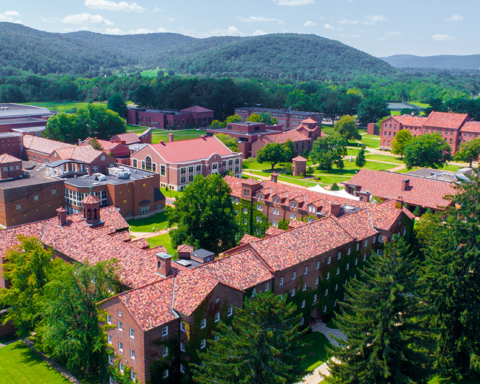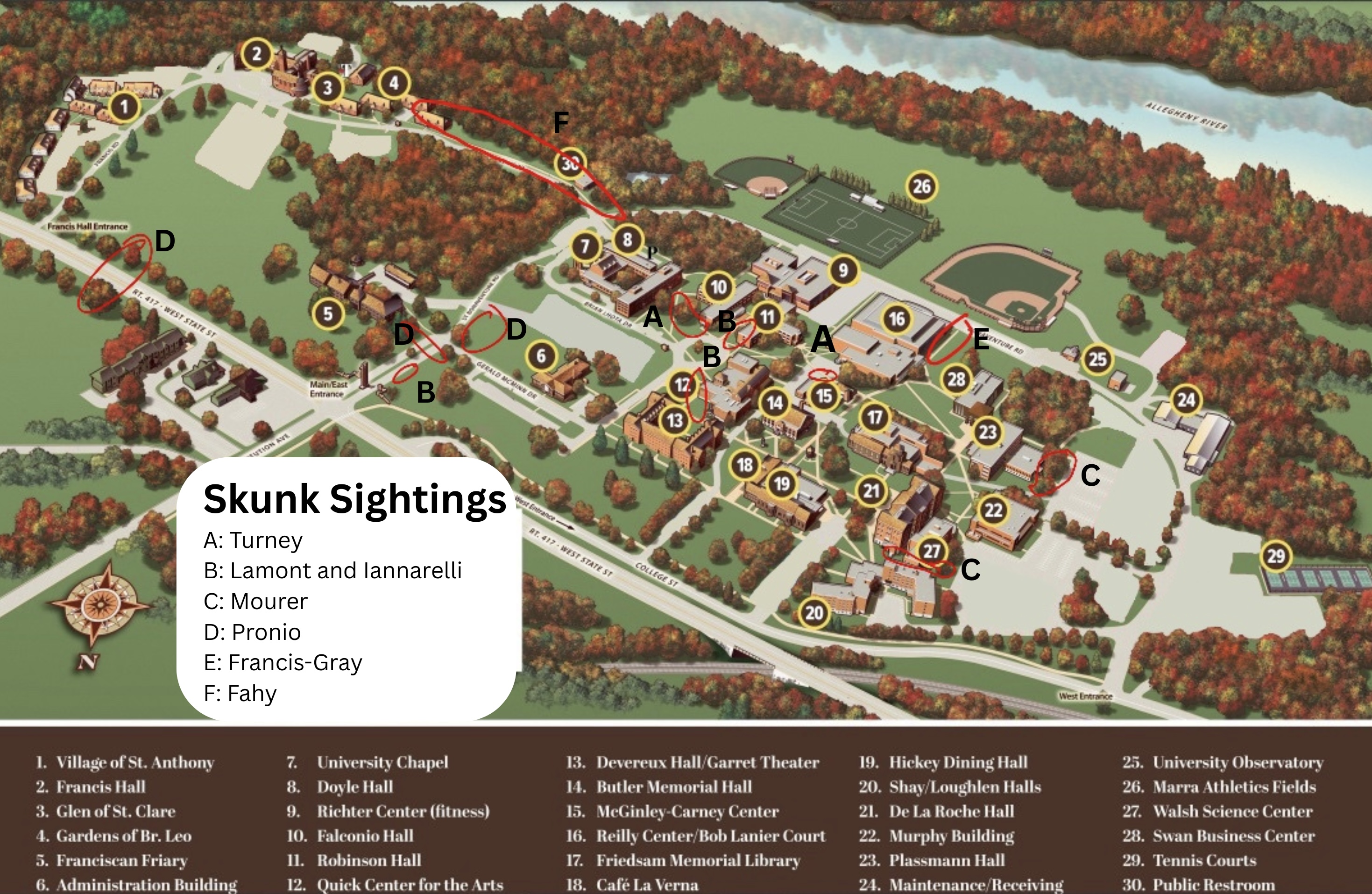
Edited map of St. Bonaventure University campus to show skunk sightings
Original photo courtesy of sub.edu
BY: CHRIS DOODY, CO-EDITOR-IN-CHIEF
Students and staff have repeatedly noticed skunks around St. Bonaventure University’s campus. Some have given the skunks names, others fear being sprayed, most are inconvenienced.
“A parent came up to a group of RAs and I and told us that they saw a skunk near the Robinson Falconio Hall courtyard on freshman move-in day,” said Lily Peterson, a sophomore health science major. “A few minutes later we saw the skunk walk by the courtyard windows, one of us called Safety and Security to see if they could do anything.”
Campus Facilities said they have not received any complaints regarding skunks on campus despite students contacting safety and security.
“We have not gotten any complaints/emails about skunks this year so far,” said Jared Smith, Director of Facilities Operations.
Some students have gotten so familiar with the skunks on campus, they have given them names.
Lydia Lamont, a freshman early childhood education major, said “Scott Skunk and his wife Scarlet Skunk” live somewhere outside of Robinson and Falconio Hall.
Encountering the skunks has become a part of some students’ nightly routine.
“Lydia and I go on a walk almost every night around 9 [PM],” said Alexandra Iannarelli, a freshman health science major. “We were walking towards the quick center, when we saw Scott [the skunk] and we turned to get away from him. We then saw a group of guys heading in that direction and warned them that Scott was there. But they kept walking. Then we heard them yell ‘rotate’ and they turned around and ran.”
Skunks have been spotted across campus.
“I see the skunks a lot between Loughlen [Hall] and De La Roche,” said Travis Mourer, a freshman adolescence education major. “I’ve also seen them behind Plassmann Hall.”
Aidan Fahy, a senior environmental studies major, has focused a lot on skunks in his classes.
“Skunks are way more common at St. Bonaventure than most people would think, I’ve personally ran into about a dozen this year,” said Fahy.
Skunks are primarily nocturnal animals.
“Most of the time skunks come out around after sunset,” said Fahy. “They like staying around the edge of the woods. So, if you are walking between Doyle Hall and Francis Hall or Townhouses and Gardens, you would see more there.”
Skunks have a poor sense of vision.
“They are less likely to see you, than you are to see them because they have very poor eyesight,” said Fahy. “You probably won’t be able to see them unless you catch them in the light, but they can’t see you either.”
Fahy recommended students try alerting skunks of their presence, but cautions them to not scare the skunks.
“Skunks have powerful hearing, so my trick when I see them is I say ‘Hi skunk’ to let them know I am there,” said Fahy. “You don’t want to startle them, we all know what happens then, instead just make sure they are aware of you.”
Fahy said skunks won’t spray you at first.
“If they get startled or spot you, they stamp their feet on the ground and use this as a warning mechanism to everyone around them to not mess with them,” said Fahy. “If that is not successful they stand up on their front legs, and bend over backwards and spray.”

Skunk in grass
Photo courtesy of The Bona Venture
Some students have had face-to-face contact with the skunks.
“I went on a walk by myself the other night and stopped to sit at the table outside of Umin [The McGinley-Carney Center],” said Emma Turney, a freshman criminology major. “I heard rustling in the bushes behind me, so I turned around and saw a skunk and I locked eyes. I rushed to get up and leave, but then I saw another one. I was cornered between two skunks.”
One student sees the skunks some nights while leaving their job on campus.
“I get out of work very late, around 12:30 AM, and I ride my bike from the Rathskellar [to the East side of campus] and I see skunks often,” said Olivia Francis-Gray, a junior communications social justice and advocacy major. “One night I was in front of the Riley Center, and I saw a skunk, and it made clear eye contact with me. I was very startled at first.”
One student finds the skunks cute, but said she didn’t want to be sprayed.
“I was walking back [to my dorm] from a late-night study session in Plassmann hall, when I saw a skunk near the library,” said Katherine Tedesco, a psychology and health science dual major. “I was like ‘Oh my God’ I had never seen one before. It was really cute. I was worried I’d get sprayed and started wondering what I would do if I did get sprayed.”
The skunks have been spotted across campus.
“I watched a skunk run under the light [on the North side of Falconio Hall] and then went towards a tree outside of Doyle Hall,” said Turney. “I think it lives around there.”
Iannarelli said she smelled what she thought to be a skunk outside of Robinson Hall on September 29.
The skunks also sometimes block traffic.
“I saw four skunks in one night on my way home,” said Natalie Pronio, ministry coordinator “One crossing from the Friary to the Administration parking lot, one near the parking lot outside of Doyle Hall, and two crossing West State Road coming from the lawn in front of Francis Hall going towards the group of houses. Traffic was stopped for the skunks.”
Some students have been warning each other about the presence of skunks on campus.
“On one of our walks a car pulled up next to us, close to the Administration parking lot, they warned us that they saw a skunk up ahead,” said Iannarelli.
Some students are concerned about the presence of the skunks.
“I don’t want to have to put tomato soup on myself,” said Francis-Gray. “Some say skunks are their friends, but I don’t think they’re friends of mine.”
Other students are taking it into their own hands to get rid of the skunks, accidentally.
“The other night one of my friends hit and killed one of the skunks on campus [with their car],” said Grace Fry, a dual degree nursing major.
Facilities said the skunks are not a problem on campus.
“As far as I know nobody has been sprayed on campus before,” said Smith. “If an issue becomes serious enough then we can set a live trap but that is typically a last resort as the best option is always to leave any wildlife alone.”
One student is advocating for the removal of skinks from campus.
“They need to relocate the skunks,” said Turney.